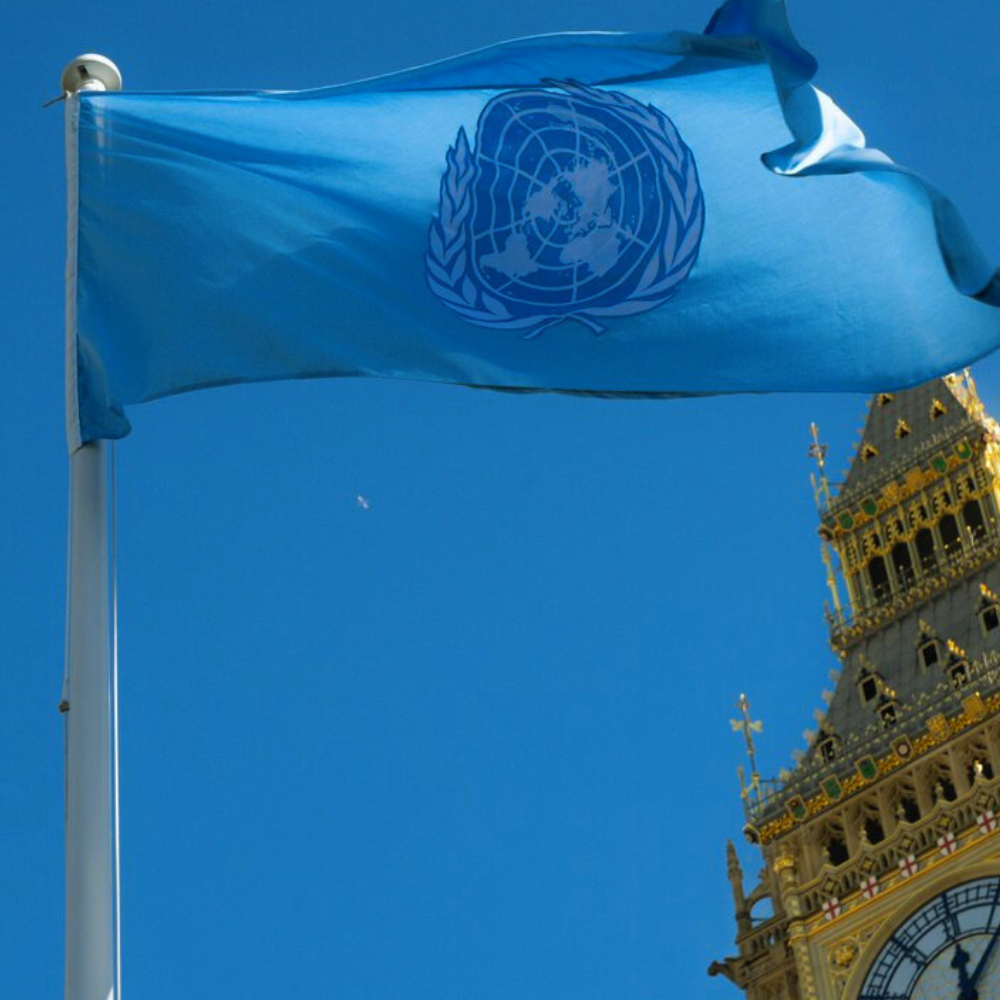
At the recent UN 80th anniversary event in London, it was striking how consistently the language of future generations, foresight and long-term risk surfaced across discussions. Even as the multilateral system shows clear signs of fatigue, the questions shaping its future are increasingly generational.
The event brought together a wide cross-section of the multilateral ecosystem – from senior UN figures and former political leaders to civil society and security practitioners. What stood out was not the introduction of new commitments, but the extent to which long-term perspectives are now being treated as a baseline rather than an add-on. References to future generations, youth and foresight appeared across panels, and chairs repeatedly cued discussion in that direction. The narrative shift is clear, even if its institutional expression remains uneven.
That tension was evident throughout the day. While there were explicit calls for stronger leadership – including renewed discussion around the role of a Special Envoy for Future Generations – there was also a shared recognition that commitments alone are no longer the constraint. As several speakers put it, the challenge has moved from agreement to execution: how multilateral institutions build the capability, coordination and political space to act on interconnected, long-term risks.
“There are some decisions we have to take that are so important that future generations should have a vote. The UN has recognised this principle with the ongoing work on the Declaration on Future Generations. Some national Parliaments already build on that concept and ours should do the same. Intergenerational cooperation and forecasting need to be baked into national and international political decision making.” – Lord Robertson
Three signals shaping the next phase
Several themes from the conversations felt particularly important for how the future generations agenda is likely to evolve next.
First, attitudes to multilateralism and solidarity are shifting in non-linear ways.
New polling shared during the event challenged some common assumptions. While longer-term trends show increasing support for multilateral cooperation across generations, recent data points to a sharp short-term drop in confidence among younger cohorts in some countries. At the same time, support for internationalism is rising elsewhere, including in parts of the Global South. This suggests that what is being rejected is not necessarily global cooperation itself, but particular institutions, narratives or perceived failures. Language, legitimacy and political framing will matter as much as formal commitments in sustaining support.
Second, financial systems are increasingly recognised as a structural blocker to long-term problem-solving.
Across different interventions, there was a shared critique that current capital flows systematically favour short-term extraction over long-term resilience. This misalignment undermines efforts to address interconnected systemic risks, regardless of the strength of treaties or declarations. Without greater coherence between governance frameworks and financial incentives, long-term commitments will struggle to translate into real-world impact.
Third, inequality is emerging as both a destabiliser and a potential catalyst for change.
Inequality featured more prominently than expected, framed not only as a driver of distrust in governance and scapegoating of multilateral institutions, but also as a force that could reshape politics. Among younger groups in particular, there are signs that inequality could become a new form of populism – not necessarily regressive, but capable of accelerating demands for redistribution, fairness and institutional reform. Volatility, in this sense, may open as well as close political space.
Taken together, these signals point to a multilateral system in transition. The language of future generations has entered the mainstream of strategic conversations, but the next phase will be defined less by new declarations than by whether institutions can adapt their capabilities, incentives and narratives to a rapidly shifting political context.
If the UN at 80 risks feeling old, these conversations suggested that the questions now shaping its future are anything but.
Read the updated Implementation Handbook for the Declaration on Future Generations.