Finland Hub: Mainstreaming a Future Generations lens into societal debate
Challenge
Approach
Outcome
Finland has a long history of leadership in future-oriented policymaking, anchored in institutions like the Parliamentary Committee for the Future and its governmental foresight unit. But there was an appetite to go further: by embedding long-term governance principles beyond these existing structures, and building a shared understanding of what stands in the way of long-term governance more broadly and articulating together a common language for talking about it; one that could bring together government actors, researchers and NGOs who had not consistently engaged with one another before.
The Finnish Hub, weaving together a wide network of motivated actors, began by co-creating the white paper Towards Long-Term Governance: From Future Awareness to Action, setting out three routes to overcome short-termism: embedding foresight in decision-making, expanding futures literacy, and strengthening recognition of future generations’ rights.
Since this inception phase, the Hub has convened numerous events in Finland and Brussels, each with a distinct focus and audience, drawing in MPs, UN youth delegates, academics and NGO leaders as both participants and speakers:
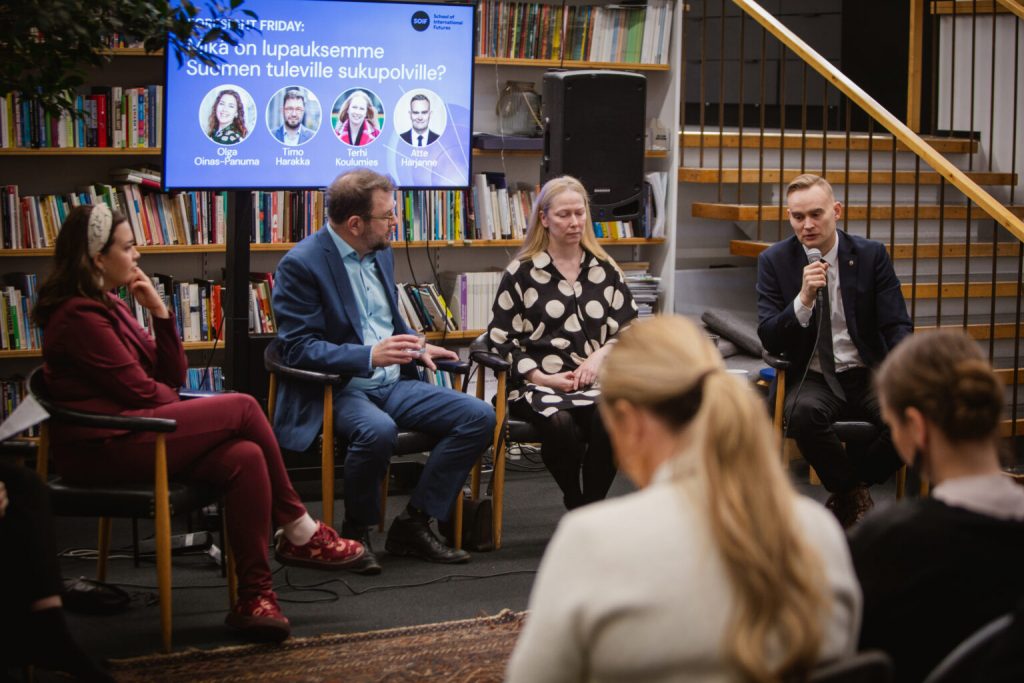
A cross-party conversation on Finland’s promise to future generations. On 5 December 2025, the eve of Finland’s Independence Day, the Hub hosted Foresight Friday: What is our promise to Finland’s future generations? SOIF Future Generations Adviser Sophie Howe opened with reflections on Wales’s experience and the international momentum around intergenerational fairness, followed by a panel of four sitting MPs: Terhi Koulumies (National Coalition Party), Atte Harjanne (the Greens), Timo Harakka (Social Democratic Party) and Olga Oinas-Panuma (Centre Party). Independence Day is traditionally a moment to remember the generations who came before; the panel deliberately turned the question around—if we are grateful to those who preceded us, what will future generations remember us for? A sentiment ran through the panel: Finland has the foundations for long-term action, including a strong sense of intergenerational solidarity, but issues like mental health, climate and young people’s faith in the future demand structures and cross-party commitment that reach beyond any single government term.
Bridging Finland with the European conversation. In connection to the Commission’s work on the Intergenerational Fairness Strategy, the Hub contributed to Strengthening Intergenerational Fairness and Long-Term Governance in Europe in Brussels, hosted by the Prime Minister’s Office of Finland, Sitra and SOIF with the Finnish Permanent Representation to the EU. The Hub then brought the conversation home with Fair decision-making across generations: what does the EU’s new strategy mean for Finland?, an online convening held primarily in Finnish that translated the Commission’s newly published Intergenerational Fairness Strategy into the Finnish context. Following an introduction from the Commission, a panel of Finnish MP, youth and civil society voices grounded the strategy in national realities.
Through events, media and communications, the Hub has established the relevance of intergenerational fairness to current debates in Finland, and clarified Finland’s distinctive positioning within the wider international conversation—including the UN Summit of the Future and the EU’s new Intergenerational Fairness Strategy.
A shared diagnosis and language.The Hub has deepened the diagnosis of the impact gap in foresight and long-term governance, and helped develop a constructive language around it. The white paper has become a common reference point across the ecosystem.
A more connected ecosystem.The Hub has brought together communities working towards fairer futures that had not consistently engaged with one another before: foresight, wellbeing economy, global justice and development, and participatory policymaking. Convening them around intergenerational fairness as a connective thread has begun to surface shared priorities, rather than parallel agendas running on separate tracks.
Parallel momentum in Finland. The Hub’s activities have contributed at a time when the broader Finnish conversation has gained visible momentum in its own right. An op-ed co-authored by Sophie Howe and Timo Harakka, Vice Chair of the Parliamentary Committee for the Future, was published in Helsingin Sanomat, the country’s leading national newspaper. In April 2026, the committee proposed an intergenerational responsibility law, as a means of securing genuine commitment and strengthening young people’s faith in the future. Just before the summer recess, this translated into a legislative motion for intergenerational fairness and the rights of future generations, prepared by all parties on the Committee for the Future. The motion gathered 125 signatories across the aisle—out of a theoretical maximum of 178—and is likely to become law in the next government period.
The cross-national dimension was equally notable: Finnish MP Timo Harakka travelled to the UK to present to British parliamentarians, as part of a SOIF event, on the value of a Committee of the Future for the British Parliament—a demonstration of the peer learning and policy diffusion the LTG programme is designed to catalyse.